Calafate Balcon Experience
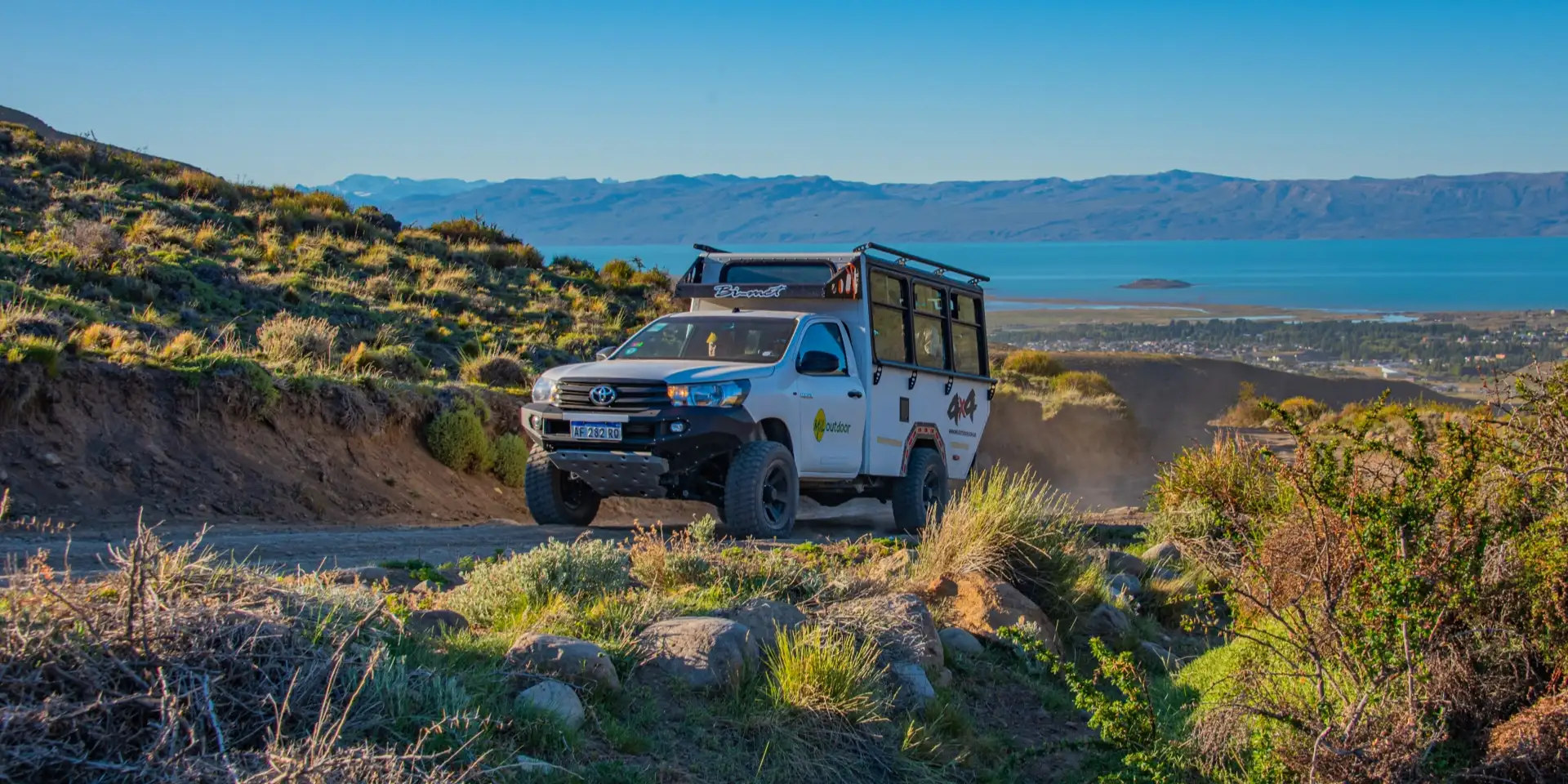
The Calafate Balcon Experience is a journey designed to observe the territorial scale of Patagonia from an elevated perspective. The route unfolds primarily on Cerro Huyliche, situated 1,050 metres above sea level, and uses 4x4 vehicles to reach observation points that are not accessible by conventional means. The outing focuses on direct contact with the geography of Santa Cruz province, integrating observation of Andean relief and glacial water bodies.
Geology and landscapes of Cerro Huyliche
The route covers approximately 35 kilometres of Patagonian terrain, crossing formations with a deep geological history. One of the notable points is the Laberinto de Piedras, a set of rock structures dating from the Cretaceous period, estimated to be 85 million years old. This section offers a view of erosion and landscape modelling across geological eras.
From the natural lookouts on the hill, the view extends across the central body of Lago Argentino. The route allows visitors to identify the Boca del Diablo, which functions as the narrowest passage of the lake as it extends toward the Upsala arm. On days with clear weather conditions, visibility reaches the silhouettes of Cerro Fitz Roy and Cerro Torre, located in the El Chaltén area, visually connecting the lake region with the Andean massif.
Observation of the natural surroundings
The experience is characterised by strategic stops that facilitate observation of local biodiversity. Condor flight is a recurring feature in this environment, making use of thermal currents in the high-altitude zones. The combination of the Andes and the Patagonian ice field, where the region’s glaciers originate, forms the constant physical backdrop of the route.
The descent along the northern slope of the hill toward points such as the Piedra de los Sombreros completes an observation sequence that integrates different altitude levels and vegetation types. The activity provides an understanding of the relationship between the high peaks and the glacial lake basin, offering a clear reading of how ice and geology have shaped the current landscape of El Calafate.